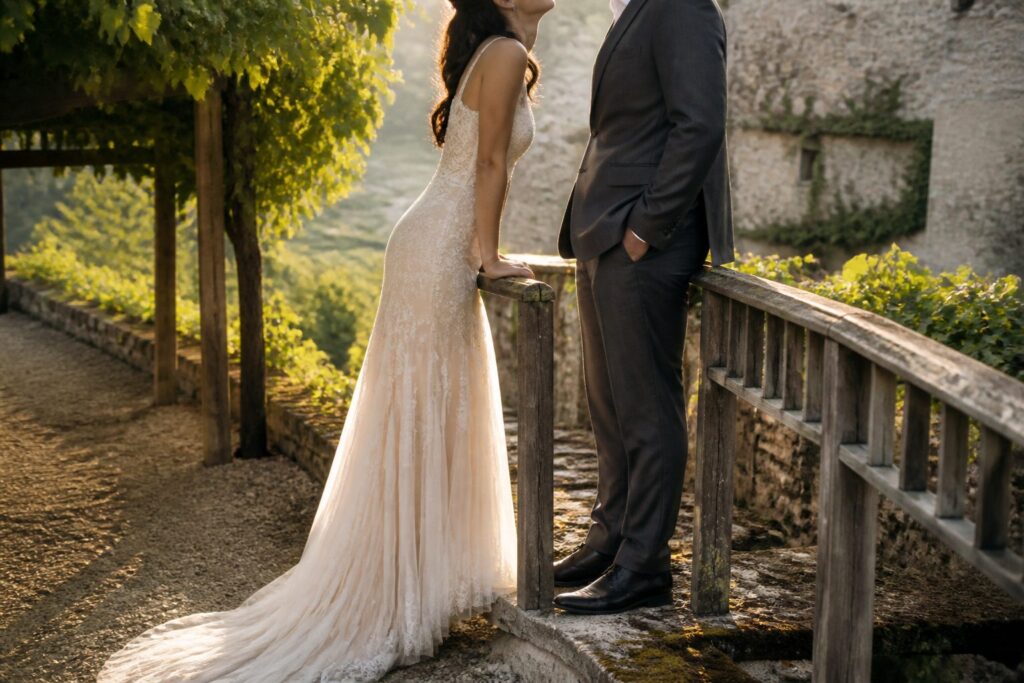
Bride and groom photography for couples with a height difference is a matter of asking one question before any pose: whether they want their gap visible or softened.
Early in my work, I defaulted to evening things out until a bride asked me to reshoot so she could actually look small beside her groom, a full head shorter.
The article below covers the techniques that follow from that first answer, from staircases at 36 inches wide for a 6-inch difference to the seated poses that bring faces level without anyone looking folded in half.
Ask About Height Preferences First
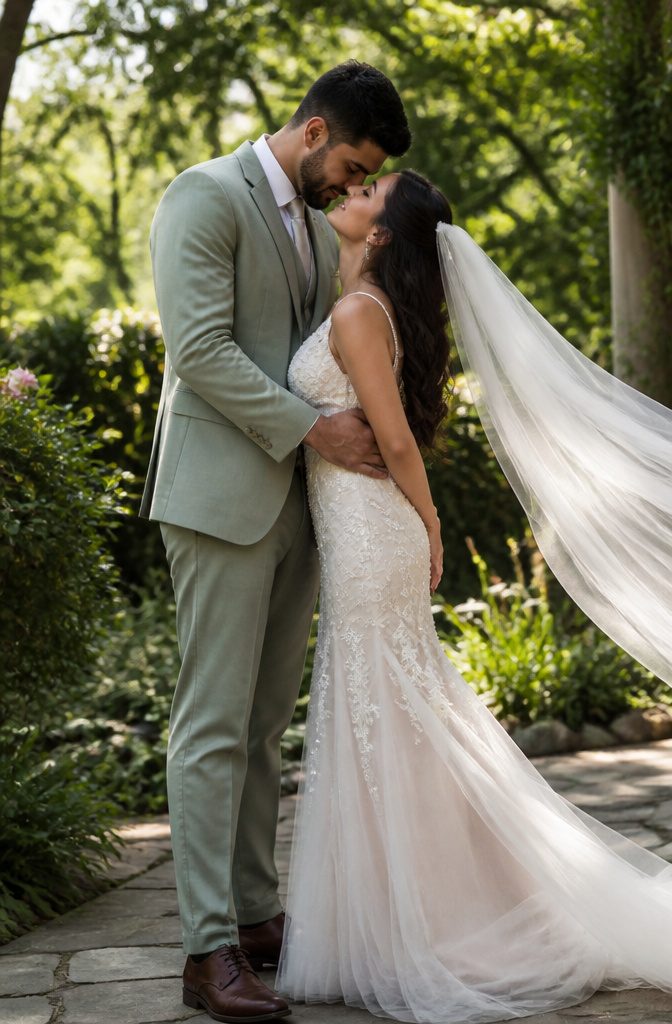
The first thing I ask a couple, before we walk to any backdrop or test any light, is whether they want their height difference visible in the final images or softened.
Most photographers skip this entirely and start posing from habit, which is how I learned the hard way that assumptions cost time.
Early in my work, I photographed a groom who stood a full head taller than his bride. I defaulted to my usual approach: stepping him down, bringing her up, doing everything to even the gap.
Halfway through the session she asked, quietly, if we could shoot one where she actually looked small next to him. She liked the contrast; it felt like them.
We had to backtrack and reshoot several setups, and the light had already shifted. Now I ask directly, and I frame it as a choice between honest scale and gentle balance, not a problem to fix.
The question also surfaces whether one partner feels self-conscious about the gap, which changes every pose that follows.
A couple who wants the difference celebrated stands differently than one who wants it minimized, and no amount of technical skill substitutes for knowing which version they are.

Size:6 x 4 ft (180 x120cm),our Backdrop is easy to decorate or hang anywhere you like.

❤[SUITABLE SIZE] The size of this banner is 7x5ft and can be used as a backdrop for party and home decorations.

Material and Size: This backdrop adopt high quality fabric polyester,which makes the pattern more realistic. 7Wx5H
Use Staircases for Natural Levels
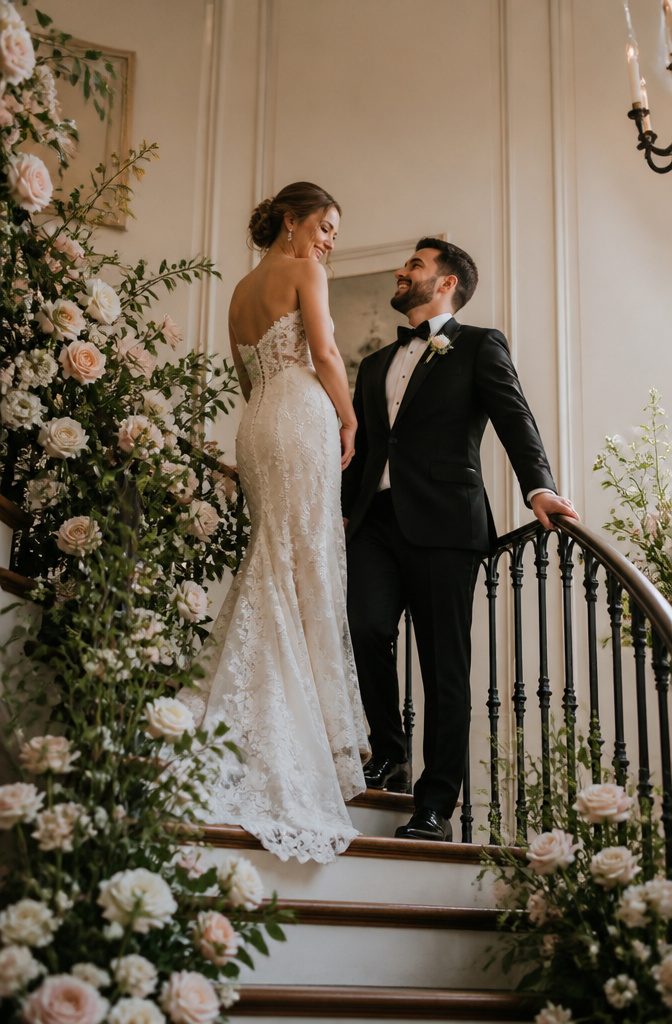
Staircases solve the height gap only if you scout them before the wedding day.
I walk the venue looking for steps that let me place the shorter partner one step above without the pose looking like a setup. The mistake that still burns me happened at a garden venue with a grand double staircase.
I put the bride three steps up, and in the frame the distance between them looked forced, almost comical. The couple laughed about it later, but those shots were unusable.
A standard 36-inch residential stair width works for couples with about a 6-inch difference, giving enough room for natural body angles without the gap reading as empty space.
For a 12-inch difference, I look for narrower stairs, around 30 inches, which compress the scene and keep the pair visually connected.
Wider stairs exaggerate the separation; the eye notices the architecture instead of the couple. If the venue only has broad commercial steps, I skip the staircase entirely rather than fight the geometry.

Unique Couple with Dog Figurine - Designed especially for dog parents. This couple and puppy statue depicts a happy couple and their beloved dog, forming a sweet family of 3. It is a simply beautiful visual expression of love between the man, woman and fur baby. Every time one sees this cute room decor, it brings back sweet memories

Life-Size Skeleton Couple for Spooky Atmosphere: This 5.4 FT life size skeleton couple instantly elevates your haunted house or yard with eerie charm. Featuring movable joints for dynamic poses, the bride and groom can hug, dance, or strike creepy stances that captivate guests and create unforgettable Halloween memories for family and friends.
Seat Both Partners Close Together
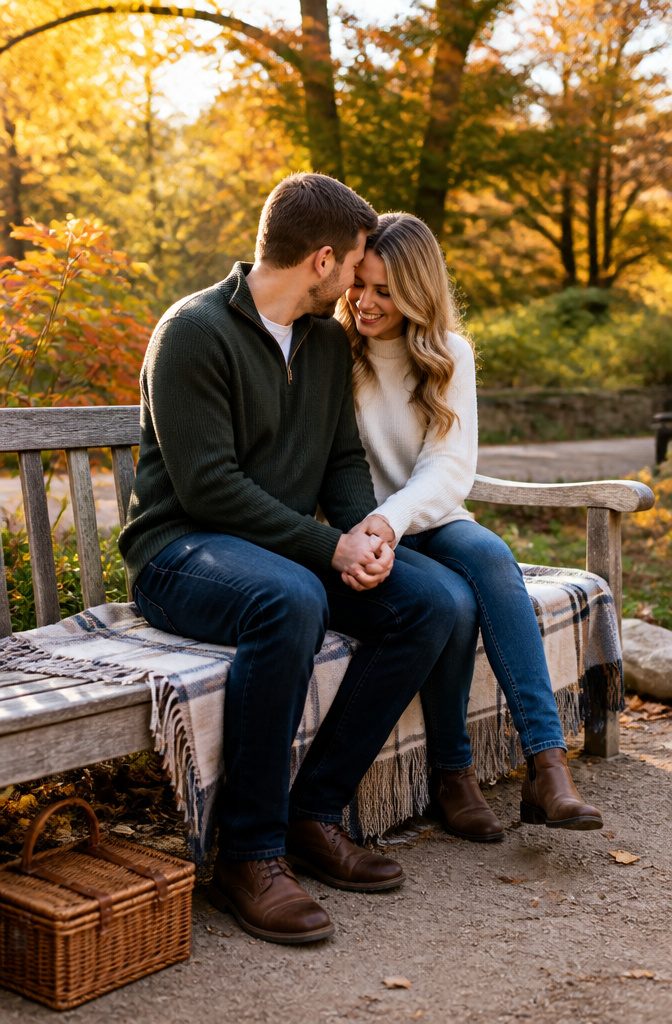
A bench with both bodies angled in, knees touching or nearly so, is the most reliable way to bring faces level without anyone looking folded in half.
I shoot these from roughly a 45-degree angle off the front corner, never straight on. Straight-on bench shots flatten thighs against the seat until they spread wide and unflattering, and no amount of later work fixes that.
A low wall with feet dangling works the same way. The height difference disappears from the waist up, and the dangling legs give the photo a loose, unposed energy that couples tend to love when they see it.
The picnic blanket setup, knees touching, chin in hand, leaning toward each other, can look warm and golden-hour perfect.
The camera stays at seated eye level or slightly above. Drop below that and you are shooting up into chins.
I stopped using the pose with one partner perched on the other’s lap, both facing forward.
The height never actually matched without the seated partner hunching, and I was always cropping out an awkward elbow or a foot that had nowhere to go.

Wood photography props--the fine craftsmanship and hand-polished finish give this wooden stool elegant look and feel,small stool wood

Small bench: 🎍🎍🎍🎍 the wooden pedestal stand can be placed directly in many places, such as the room, bedroom, study room, dining room, bathroom, balcony and more, to hold bonsai, seasoning box, soup, shampoo, cake, cup or other household items
Pose One Seated, One Standing Behind
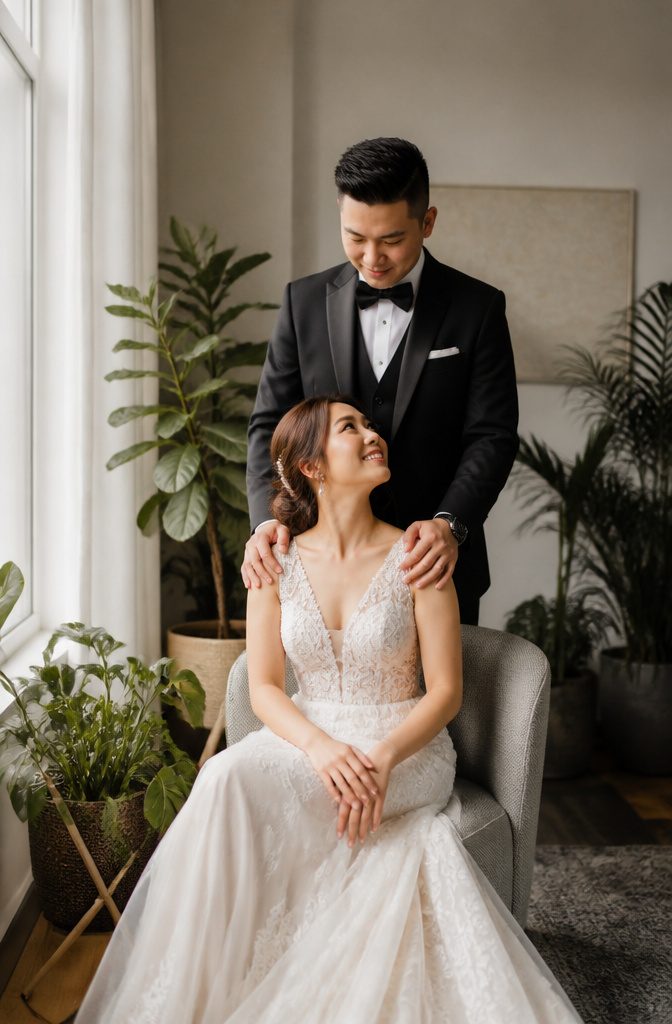
The seated-standing arrangement works best when the shorter partner takes a chair with a low back, nothing that rises above the shoulder blades.
I place the taller partner directly behind, hands resting light on the seated shoulders or gripping the chair top, and the height gap collapses into a single clean vertical line.
The seated person’s gaze should land on the standing partner’s collarbone or chin, never the nostrils, which means I ask them to look up through lowered lashes rather than tilt the whole head back.
For light, I set my key source at 45 degrees to the standing side and feather it across both faces; the standing partner’s brow ridge throws a shadow downward if the light sits too high, so I drop it until the catchlight shows in both sets of eyes.
A reflector on the floor, angled up at the seated face, fills what the key misses without turning the chin shadow into a second light source.

Frame Tighter to Soften the Gap
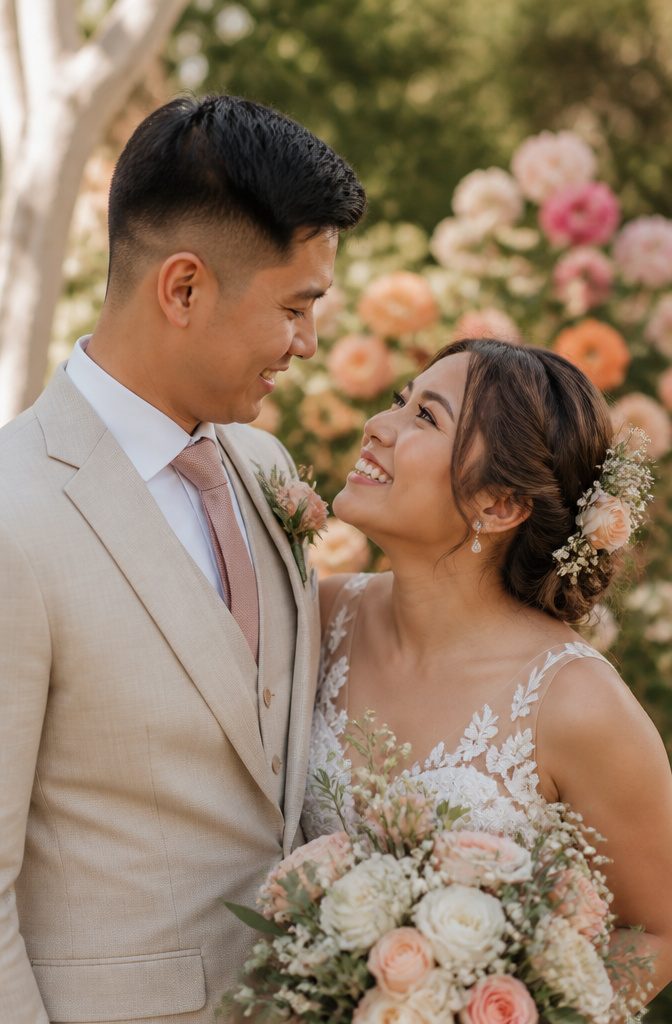
A full-body frame can turn a height difference into the only thing anyone sees. When that starts happening, I move in tighter: waist-up, or even closer if the couple wants the gap softened rather than featured.
The lens matters for this. I switch to something in the 50–85mm range, which keeps faces looking natural without the stretch a wider angle gives at close distance.
I stand about six to eight feet back, close enough to fill the frame but not so close that features distort at the edges.
The composition rule I break on purpose is leveling the shoulders.
For couples who asked to hide the difference, I let the shorter partner’s shoulder sit a touch higher in frame, tilting the camera slightly or asking the taller person to lean in.
It reads as intimate, not corrective, and in a tight crop the eye never goes looking for feet.

Strong Grip, Ensures Stair Safety – These non-slip stair treads use a self-adhesive design, ideal for wooden steps, creating a stable surface that won’t shift. Perfect for families with kids, seniors, and pets, these stair carpets offer secure footing for every step with confidence.

【Perfect wider size】:Wider and longer 36" x 36" stair treads make the stairs a wider coverage, higher stability, and more beautiful.

Perfect wider size:Wider and longer 9" x 36" stair treads make the stairs a wider coverage, higher stability, and more beautiful.
Shoot Their Real Difference When They Want It
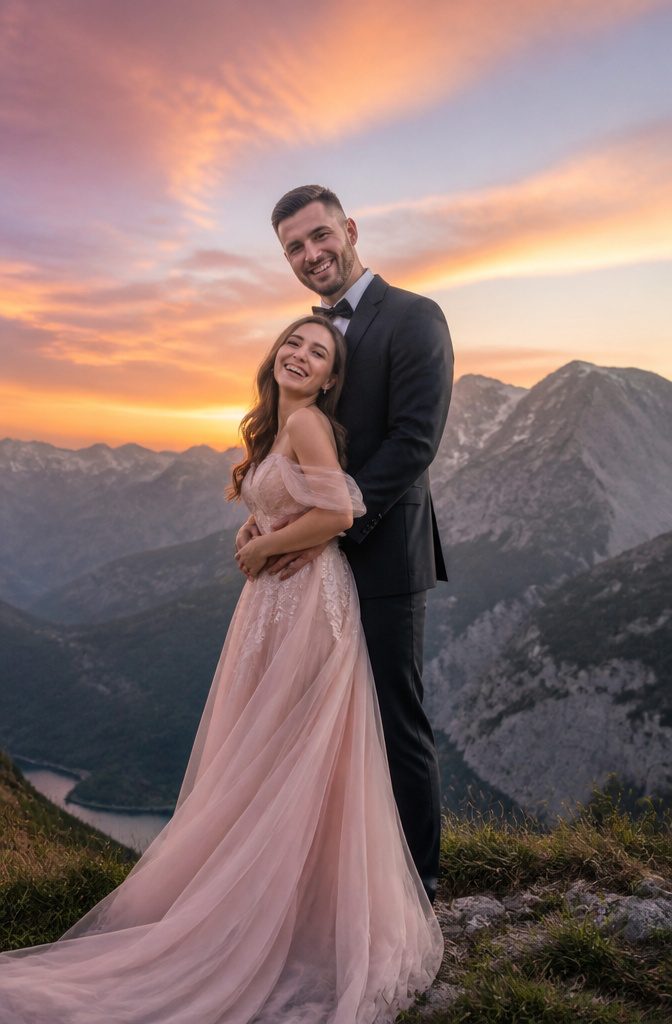
Some couples want the height difference front and center.
I always ask directly, because guessing wastes shots and trust. When they say yes, what you want is the gap looking chosen, not like a mistake you cropped around.
A bride at five feet and her groom at six foot four taught me the most. We shot seated poses first, the usual equalizers, and they were fine.
But she pulled me aside during a break and said she wanted one where you saw exactly how small she was next to him, how big he was next to her.
Not cute. Real.
I put them both standing, her slightly in front so she turned her face up to him, him dropping his chin to meet her.
The vertical line of his body became the frame; she interrupted it at the chest, which made the contrast readable without anyone looking stretched or compressed.
I shot from slightly below her eye level, which gave her presence instead of diminishment.
They chose that one for the album cover. Every seated shot went inside pages.
The risk is always caricature. If he is looking straight ahead and she is craning up at his jaw, it becomes a joke.
Both faces need to work in the same emotional register. That usually means he meets her more than halfway, physically and expressively.

❤[SUITABLE SIZE] The size of this banner is 7x5ft and can be used as a backdrop for party and home decorations.

🌿 Rustic Farmhouse Wedding Style Designed with wooden barn doors, white roses, and lush greenery, this backdrop creates a warm and authentic rustic wedding atmosphere.

Size: 18x7ft(5.5m W x 2.2m L) fall halloween backdrop (with 4 holes and 2 strings.No Pocket, No Clips and No Backdrop Stand).
Posing Techniques for Height
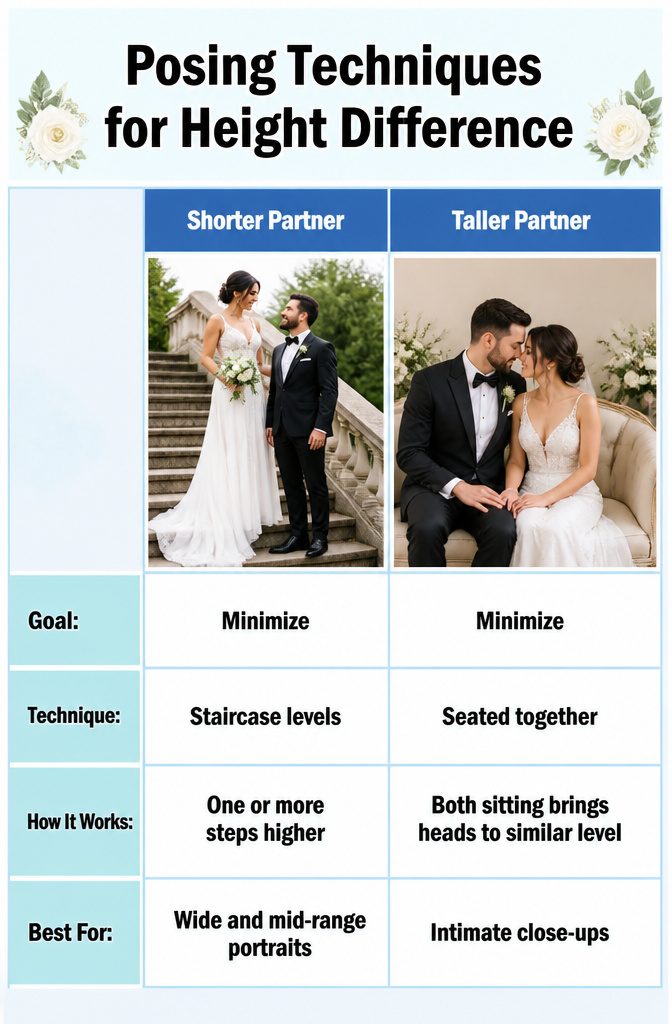
Most couples I work with know whether they want their height difference to disappear, stay neutral, or stand out in the final gallery. The challenge is matching that goal to the right technique without flipping back through six separate sections.
This table groups every posing approach by what it does to the gap, so you can scan for the effect you want and find the move that creates it.
| Goal | Technique | How It Works | Best For |
|---|---|---|---|
| Minimize | Staircase levels | Shorter partner one or more steps higher; keep some visible difference so it does not look forced | Wide and mid-range portraits where you still want full bodies |
| Minimize | Seated together | Both sitting brings heads to similar level; lean in, kiss, or stay close waist-up | Intimate close-ups and relaxed moments |
| Minimize | Tighter framing | Shoot waist-up or closer so legs and full stature stay out of frame | Quick transitions, candid feel |
| Neutralize | One seated, one standing behind | Standing partner leans over or embraces; the height becomes part of the pose rather than the subject | Romantic, protective mood |
| Emphasize | Shoot their real difference | No correction; let the couple’s natural heights read as they are | Couples who want honest, documentary-style images |
The staircase option is the one I see mishandled most often.
The shorter partner should still read as shorter; matching heights exactly looks strange and feels like a correction rather than a flatter pose. Subtlety saves it.
Composing Around the Couple
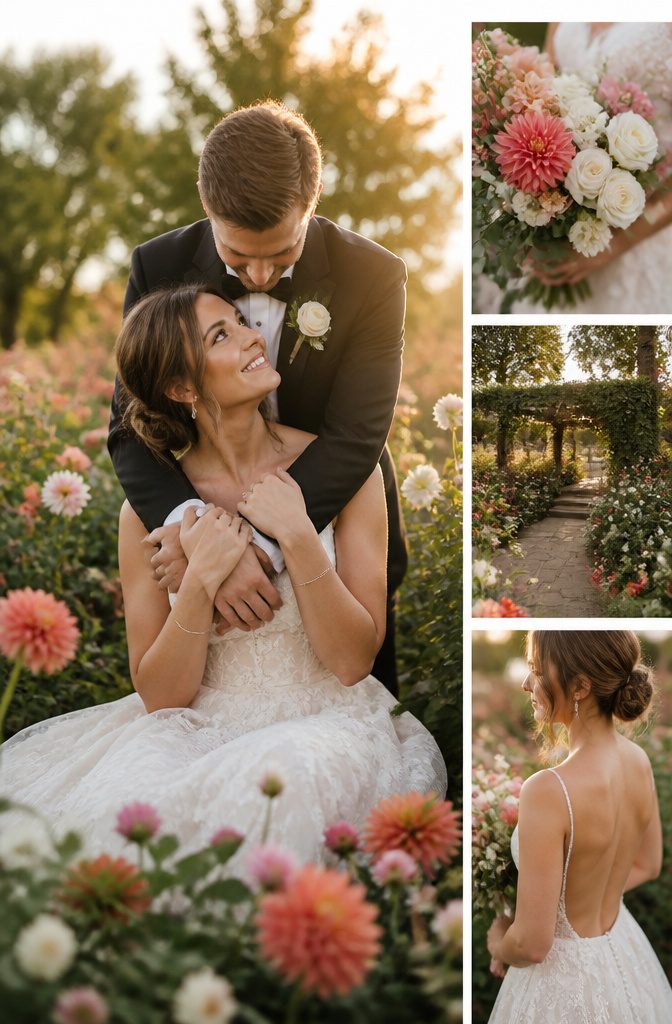
Angle selection, lens choice, and framing all serve the same purpose in bride and groom photography: keeping the viewer’s eye on faces and the connection between them rather than the vertical gap.
A slight downward camera angle on the taller partner, or shooting from the shorter partner’s eye level, brings faces into alignment without the posture looking forced.
Wide-angle lenses exaggerate whatever is nearest the camera, so placing the shorter partner slightly forward can stretch them proportionally, but keep the shift subtle enough that it reads as natural stance, not optical trickery.
Tighter framing from the waist up removes feet-to-chin distance from the equation entirely.
Staircases and seating arrangements handle the rest in environmental ways other sections cover; here the decision is simply whether to let the height difference show or to compress it through proximity in the frame.
I lean toward compression for formal portraits, since the album page is small and vertical space eats emotional detail. For the couple who wants their real difference celebrated, a full-body frame with both standing tells that truth without my intervention.
Frequently Asked Questions
How do you photograph a bride and groom with a large height difference?
Ask the couple first whether they want the difference visible, softened, or celebrated.
For minimizing it, use staircases with the shorter partner one step up, seat both partners together at a 45-degree angle, or shoot tighter waist-up frames with a 50–85mm lens.
For couples who want their real height shown, pose them both standing with the shorter person slightly forward, so the gap reads as intentional and honest.
What are the bride and groom photos called?
In wedding photography, the formal portraits of the couple together are typically called "couples portraits," "bride and groom portraits," or simply "formals."
These are the posed or semi-posed images shot after the ceremony or during a dedicated session, separate from candids and reception coverage.
How much should you spend on photography for a wedding?
Wedding photography pricing varies widely by region, experience, and package inclusions, with many couples in the US investing anywhere from $2,000 to over $6,000.
Allocate roughly 10–15 percent of your total wedding budget toward photography if preserving the day in images is a priority.
Is $4000 a lot for a wedding photographer?
$4,000 sits in the mid-to-upper range for most US markets, landing above entry-level rates but below premium luxury pricing.
It typically buys an experienced photographer with a solid portfolio, full-day coverage, and professional editing, though not the most exclusive names in high-cost cities.